A scale gives you a number. It can’t tell you whether that number is right. The tool that answers that question is the body condition score (BCS), and it needs nothing more than your hands, your eyes and about two minutes.
This clicked for me while working through the nutritional assessment chapter of my Advanced Pet Nutritionist course. The notes end with a list of common clinical mistakes. Mistake number one is “only looking at the weight number and ignoring BCS and MCS.” I had to read it twice. If that’s a mistake many professionals still make, the rest of us make it all the time.
So here are my study notes, turned into an owner’s toolkit: the score, the home check, its muscle partner, an ideal-weight estimate and when to call your vet.
These are study notes, not veterinary advice. Your vet is the right person to score your pet and set any weight goal.
What a Body Condition Score Actually Measures
A body condition score estimates fat stores, not weight. A vet scores it by feeling the fat over the ribs and looking at the body’s outline from above and from the side.
There are two common scales. The NRC’s Nutrient Requirements of Dogs and Cats describes both: one runs from 1 (emaciated) to 5 (obese), the other from 1 to 9. The NRC notes the 9-point version’s advantage: it needs no “half” points. My course notes agree and recommend it for tracking a weight programme. The WSAVA Global Nutrition Committee’s charts use it too.
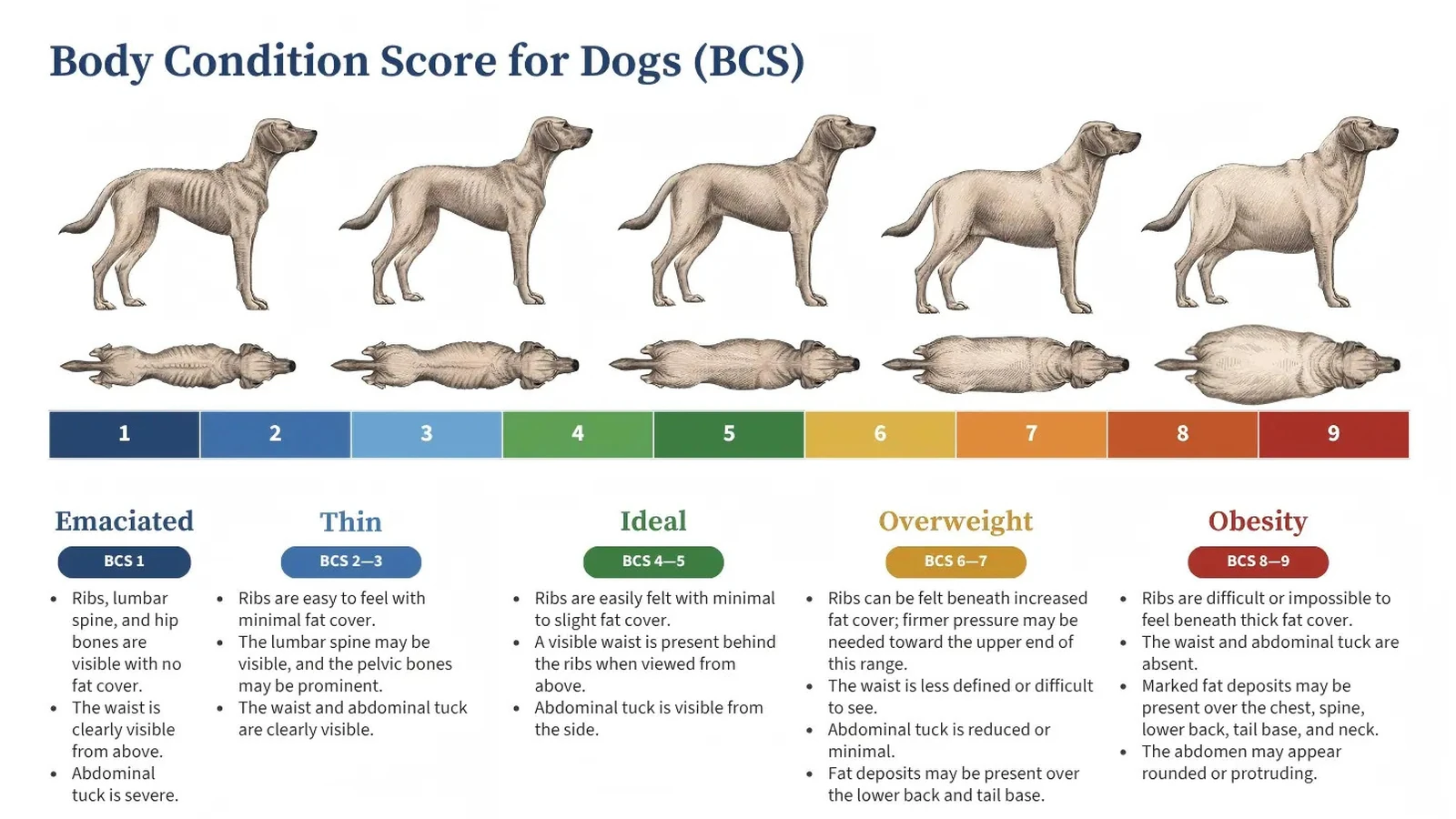
Ideal is 4–5 out of 9 for dogs and 5 out of 9 for cats. If your vet uses the 5-point scale, 3/5 is ideal, and most points on it span two points of the 9-point scale.
Here’s the number that makes the scale useful. The 2014 AAHA Weight Management Guidelines state that each point above 5 on the 9-point scale (or each half point above 3 on the 5-point scale) is equivalent to being about 10% overweight. So a dog at 7/9 is carrying roughly 20% more weight than it should. A “slightly chubby” label suddenly has a size.
Insight Box: What surprised me is how low-tech the tool is. No equipment, no lab test. The clinic’s first-line nutrition screen is a trained pair of hands, and hands can be trained at home too.
The 3-Step Body Condition Check for Dogs
Every BCS chart I studied boils down to three observations. Do them in this order, with your dog standing.
Step 1 — Ribs (feel). Lay both hands flat on the chest and run them gently along the ribs. At ideal, you can feel each rib easily under a thin layer of fat, without pressing. If you need firm pressure to find them, there’s too much fat. If you can see them from a distance, there’s too little.
Step 2 — Waist (look from above). Stand over your dog and look down. At ideal, the body narrows behind the ribs into a visible waist. No waist, or a straight or bulging line, means extra fat.
Step 3 — Abdominal tuck (look from the side). Crouch to your dog’s level. At ideal, the belly line rises from the bottom of the chest towards the hind legs. A flat or sagging belly line means extra fat.
Long or thick coats hide all of this. With a fluffy dog, trust your hands over your eyes.
Dog body condition score at a glance (9-point scale)
| Score | Ribs (feel) | Waist (from above) | Tuck (from side) |
|---|---|---|---|
| 1–3 Too thin | Easily felt, often visible; no fat felt. At 1–2, bones visible from a distance | Very pronounced | Severe to obvious |
| 4–5 Ideal | Easily felt, with only a thin fat covering | Easy to see behind the ribs | Belly clearly tucked up |
| 6 Above ideal | Felt, with slight excess fat | Visible but not prominent | Tuck still visible |
| 7 Overweight | Felt only with difficulty; fat over lower back and tail base | Barely visible or absent | May be absent |
| 8–9 Obese | Not felt, or only with firm pressure | Absent | None; belly may sag. At 9, fat on neck and limbs |
Adapted from the WSAVA dog BCS chart and NRC Table 3-7 (Laflamme, 1997).
Insight Box: Studying for China’s Licensed Veterinarian exam has drilled one habit into me: palpate before you judge. Coat, posture and camera angles fool the eye. Fingertips are harder to fool. When in doubt, the ribs decide.
Cats Are Different: Fat Pads and the Primordial Pouch
Cats use the same three observations, but the details shift. Ideal for a cat is 5/9, and at that score the WSAVA cat chart describes ribs felt under a minimal fat covering, a noticeable waist behind the ribs and only a minimal abdominal fat pad.
My course notes flag three cat-specific traps:
- The primordial pouch. Many cats have a loose flap of skin on the underside, between the hind legs. It swings when they walk. It is normal anatomy, not fat, and it can be there in a lean cat. Feel it: the pouch is soft, loose skin. A fat pad feels fuller and comes with a rounder body and no waist.
- The fat pad behind the ribs. Some cats carry a small fat pad there even in good overall condition. Score the whole cat, not one spot.
- Between the shoulder blades. Fat building up here is an important sign of obesity in cats.
Cat body condition score at a glance (9-point scale)
| Score | Ribs (feel) | Waist (from above) | Belly (from side) |
|---|---|---|---|
| 1–2 Very thin | Visible on short-haired cats; no fat felt | Pronounced; spine obvious | Severe tuck, no fat pad |
| 3–4 Thin | Easily felt, minimal fat | Obvious waist | Tucked; minimal fat pad |
| 5 Ideal | Felt with a minimal fat covering | Noticeable waist behind ribs | Slight tuck; minimal fat pad |
| 6 Above ideal | Felt, with slight excess fat | Present but not obvious | No tuck; fat pad present |
| 7 Overweight | Not easily felt (moderate fat) | Hard to see | Rounded belly; moderate fat pad |
| 8–9 Obese | Not felt under heavy fat | Absent | Clearly rounded; at 9, fat on face, limbs, lower back |
Adapted from the WSAVA cat BCS chart and NRC Table 3-7 (Laflamme, 1997). Don’t count the primordial pouch as fat.
Insight Box: The pouch line in my notes made me smile, because it answers so many worried owner questions. A cat can look “saggy” from the side and still be a perfect 5. That’s why the side view alone isn’t enough.
Why Owners Underestimate (Even With a Chart)
Here’s the uncomfortable part. Most of us are bad at this, and a chart alone doesn’t fix it.
In the US, the Association for Pet Obesity Prevention’s 2022 survey found that 59% of dogs and 61% of cats seen by veterinary professionals were overweight or obese. Its summary also notes that many owners of those pets thought their pet’s body condition was normal.
The 2014 AAHA guidelines cite a study (White et al., 2011) in which 39% of owners whose dogs the vet had called overweight thought their dog’s weight was acceptable.
The most striking result comes from Eastland-Jones and colleagues (2014). They asked 110 dog owners at UK vet clinics to score their own dogs. Without a chart, 60% underestimated. With a BCS chart in hand, 57% still did. That difference wasn’t statistically significant, even though 77% of owners felt the chart had helped.
My reading of this is normalisation. If most of the pets we see every day carry extra weight, “extra” starts to look “normal.” That’s my interpretation, not a finding, but it fits the data. It’s also why the hands-on steps matter more than a glance.
Insight Box: From the industry side, I notice how feeding guides on pet food packs are built: grams per day by body weight. That’s the right format, but it quietly assumes the current weight is the right weight. Feed an overweight dog “for its weight” and you’re feeding it to stay overweight. The clinic calculates on ideal weight for exactly this reason.
Muscle Condition Score: The Companion Score
BCS looks at fat. The muscle condition score (MCS) looks at muscle, and my course notes are firm that the two must be used together.
The reason is what my notes call sarcopenic obesity: too much fat and too little muscle at the same time. A pet can be overweight and wasting. The WSAVA muscle charts make the same point: animals can have significant muscle loss even when overweight. The scale may not move, because muscle lost and fat gained cancel out.
MCS is graded as normal, mild, moderate or severe muscle loss. It’s checked by feeling four areas:
- The top of the head (the temple muscles on either side of the skull)
- The shoulder blades
- Along the spine (the muscles running beside the backbone)
- The hips (over the pelvic bones)
Healthy muscle feels firm and rounded. With loss, the spine, shoulder blades or hip bones start to feel sharp, even when the belly is round.
This matters most for older pets. A body-composition table in my notes puts lean mass loss at roughly 1–2% a year in older dogs and cats, speeding up after about age 8. The same notes recommend checking MCS monthly in seniors and say screening for muscle loss is more important than BCS at that age. If you’re wondering what that means for diet, I wrote about the dietary side in The Protein Debate for Senior Dogs. The short version: don’t cut protein on your own, and let your vet guide it.
Insight Box: This was the real “aha” for me. I had always thought of a pet’s weight as one thing. It’s at least two: fat and muscle, moving in different directions. An older dog that is “the same weight as last year” may have quietly traded muscle for fat. Only your hands, or your vet’s, will catch that.
Estimating Ideal Weight From the Score
Because each BCS point above 5 is roughly 10% extra weight, you can turn a score into a rough ideal weight:
Ideal weight ≈ current weight × 100 ÷ (100 + 10 × (BCS − 5))
Two worked examples:
- A 20 kg dog at 7/9: 20 × 100 ÷ 120 ≈ 16.7 kg
- A 6 kg cat at 8/9: 6 × 100 ÷ 130 ≈ 4.6 kg
For a 7/9 pet, my course notes give a similar shortcut: current weight × 0.85. For the dog above, that’s 17 kg, close to the formula.
Now the caveats. At 8–9/9, estimates spread out. The AAHA guidelines’ own example, a 45 kg Labrador at 8/9, lands at about 32 kg, lower than this formula’s 34.6 kg. The formula also assumes normal muscle. If your pet has lost muscle, its true ideal weight may be higher than the estimate. Treat the number as a conversation starter for your vet, not a target to diet towards. (The same goes for any app or AI-generated diet plan: it can only be as good as the weight and score you feed it.)
Insight Box: My notes list “using the current obese weight to calculate energy needs” as another common clinical mistake. Weight-loss plans are built on ideal weight, which is why a vet’s feeding amount can look surprisingly small.
A Five-Minute Monthly Routine
My notes suggest weighing adult pets monthly, checking muscle monthly in seniors, and re-scoring BCS at every vet visit. Here’s that turned into one home routine:
- Same day, same time. Pick a fixed date, such as the first Sunday of the month, before a meal.
- Weigh. Small dogs and cats: weigh yourself holding the pet, then subtract your own weight. Larger dogs: use the vet clinic’s scale when you pass by.
- Run the 3-step check. Ribs, waist from above, tuck from the side. Write down a body condition score.
- Run a quick MCS check (especially for seniors): head, shoulder blades, spine, hips.
- Take two photos, one from directly above and one from the side, in the same spot and light each month.
- Log it. Date, weight, BCS, MCS, and any change in food, treats or activity.
The log matters more than any single score. Your scoring will drift; a trend across months won’t. The photos keep you honest.
When to Involve Your Vet
Book a check rather than adjusting things yourself if you see any of these:
- A body condition score outside the ideal range (below 4 or above 5 for a dog, anything other than 5 for a cat), especially 7/9 or higher, or 3/9 or lower.
- Unplanned weight change. My course notes treat a change of 5% or more in a month, or 10% or more in three months, as needing a proper check. Unexplained weight loss can be an early sign of illness.
- Any muscle loss on the MCS check, even if weight and BCS look fine.
- Before starting a diet. Cats in particular should lose weight slowly; my notes give about 0.5–1% of body weight a week for cats. Crash diets are risky for them.
And one more: ask your vet to score your pet at every visit and to check your hands against theirs. That one calibration does more than any chart.
The Bigger Picture
The more I study, the more I see BCS as a shared language as much as a clinical tool. “She’s a 7” starts a far better conversation with your vet than “she might be a bit chunky.”
What’s still open is how to close the perception gap. A chart didn’t close it in the Eastland-Jones study. Maybe a routine will: a monthly habit, a log and two photos. I’d like to see that tested.
Takeaway:
- A body condition score measures fat, not weight. Ideal is 4–5/9 for dogs and 5/9 for cats, and each point above 5 means roughly 10% extra weight.
- Check ribs, waist from above and tuck from the side. For cats, don’t mistake the primordial pouch for fat.
- Pair BCS with a muscle condition score, especially for seniors, and log both monthly with a weight and two photos.
Related: once the score tells you how much to feed, the label tells you what. See Pet Food Buzzwords: 7 Label Words With No Legal Definition.
What do you think? If you scored your own pet tonight, would you trust your hands or your eyes, and what number do you think you’d get?
This article is for education only and is not veterinary advice. Please involve your vet before changing your pet’s diet or starting weight loss.
Disclosure: I work in the pet food industry. No brands are named here, and nothing in this article is paid.
References:
- Nutrient Requirements of Dogs and Cats (NRC, 2006) — Chapter 3, “Body Condition” and Table 3-7 Body Condition Scoring System (based on Laflamme, 1997)
- WSAVA Global Nutrition Committee — Body Condition Score charts (dog, cat): https://wsava.org/wp-content/uploads/2025/06/WSAVA_BCSCat_BCSDog_Nutrition_250612.pdf ; https://wsava.org/wp-content/uploads/2025/06/WSAVA_BCSCat_BCSCat_Nutrition_250612.pdf
- WSAVA Global Nutrition Committee — Muscle Condition Score charts (dog, cat): https://wsava.org/wp-content/uploads/2020/01/Muscle-Condition-Score-Chart-for-Dogs.pdf ; https://wsava.org/wp-content/uploads/2020/01/Muscle-Condition-Score-Chart-for-Cats.pdf (toolkit: https://wsava.org/global-guidelines/global-nutrition-guidelines/)
- Brooks D, Churchill J, Fein K, Linder D, Michel KE, Tudor K, Ward E, Witzel A. 2014 AAHA Weight Management Guidelines for Dogs and Cats. J Am Anim Hosp Assoc 2014;50(1):1–11. https://jaaha.kglmeridian.com/view/journals/aaha/50/1/article-p1.xml
- White GA, Hobson-West P, Cobb K, et al. Canine obesity: is there a difference between veterinarian and owner perception? J Small Anim Pract 2011;52(12):622–626 (as cited in AAHA 2014)
- Eastland-Jones RC, German AJ, Holden SL, Biourge V, Pickavance LC. Owner misperception of canine body condition persists despite use of a body condition score chart. J Nutr Sci 2014;3:e45. https://doi.org/10.1017/jns.2014.25
- Association for Pet Obesity Prevention — 2022 State of Pet Obesity Report summary: https://www.petobesityprevention.org/2022-state-of-pet-obesity-report-summary
- PetMD — “What Is a Cat’s Primordial Pouch?” (vet-reviewed): https://www.petmd.com/cat/general-health/cat-primordial-pouch