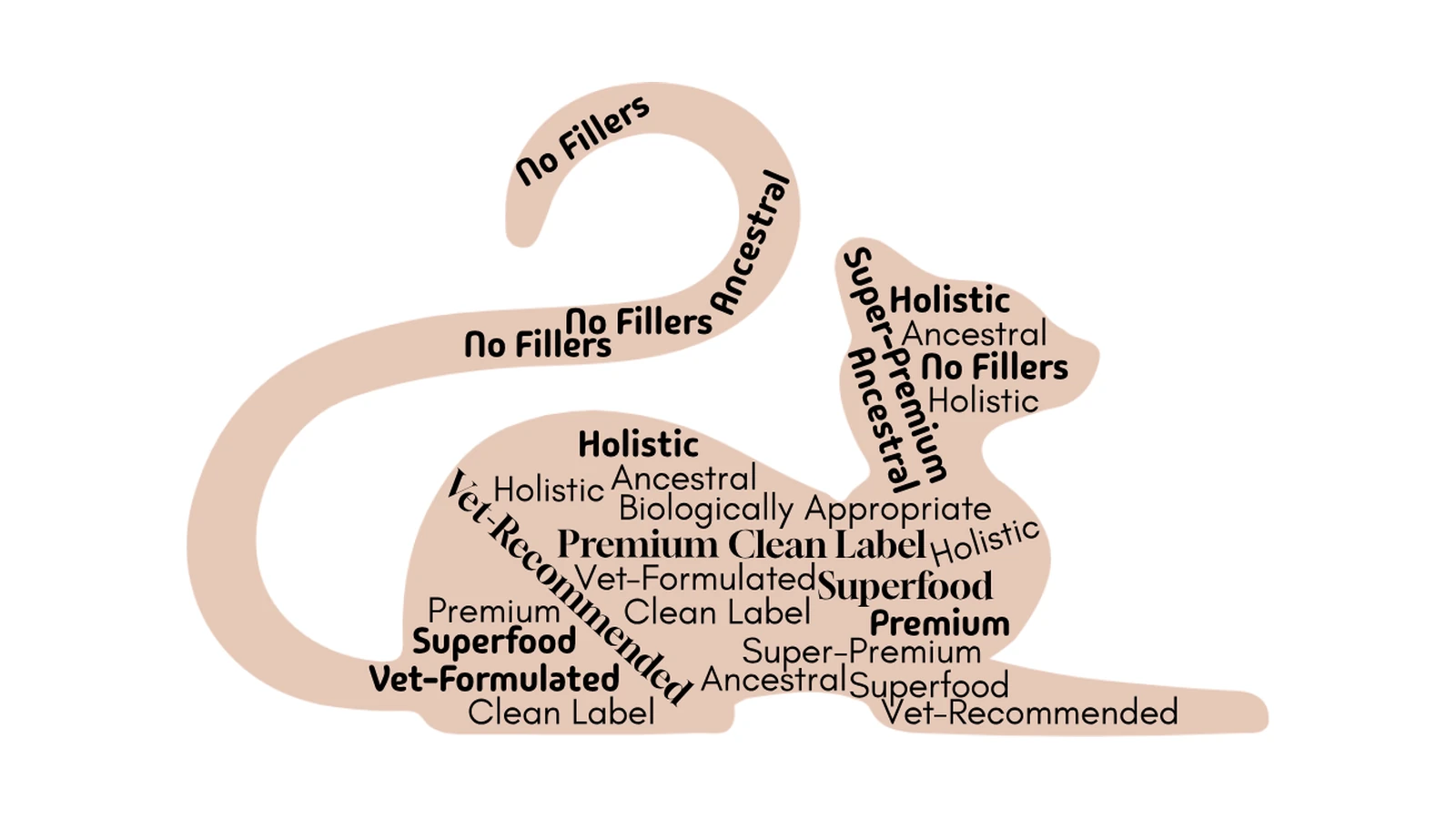
Pet food packs carry two kinds of words. Some are defined by regulation: if a bag says “natural” or “with chicken,” there are rules behind it. Others are descriptive words that no regulation defines. They tell you how a brand wants to position its food, but they don’t commit the product to any measurable standard.
This article is about the second group. I call them buzzwords, not because they are false, but because they don’t give an owner any practical guidance. For each one, I’ll cover what it suggests, what it does and doesn’t guarantee, and what to look at instead.
Disclosure: I work for a pet food company. No brands are named here, and nothing in this article is paid.
First, What Doesn’t Count as a Buzzword
Before the list, it’s worth separating the words that are regulated. These are not buzzwords, even when they appear in large type on the front of a bag:
- “Natural.” Defined by AAFCO (Association of American Feed Control Officials) in the US, by FEDIAF’s labelling code in Europe, and by China’s labelling rule (MARA Announcement No. 20 of 2018). The definitions are about processing: broadly, ingredients that are not chemically synthesised. Added synthetic vitamins and minerals must be disclosed.
- “Human grade.” An AAFCO official term with demanding supply-chain requirements: every ingredient and the finished product must be handled under human food rules.
- “Fresh.” Defined for ingredients by AAFCO and FEDIAF: not frozen, cooked, dried or otherwise preserved, except by refrigeration.
- Naming words such as “dinner,” “with” and “flavor.” Under AAFCO rules, “Chicken Dog Food” means at least 95% chicken (excluding water), “Chicken Dinner” at least 25%, “with chicken” at least 3%, and “chicken flavor” only a detectable flavour. Europe and China use a similar ladder of about 26%, 14% and 4%.
- “Grain-free” and other “free from” claims. These are factual claims and must be true. Under the FEDIAF code, “free from” means not even traces.
Each of these is a real definition. It may be narrower than many owners assume (a “natural” food can still be nutritionally unbalanced), but it can be checked. The seven words below can’t.
1. “Premium” and “Super-Premium”
What it suggests: better ingredients and higher standards.
What it guarantees: nothing specific. A Virginia Cooperative Extension guide on pet food labels states that premium and gourmet products “are not required to contain any different or higher quality ingredients” than other complete and balanced foods. My course notes also point out that a “high quality” claim in China needs support behind it. No market I know of has a legal tier called “premium.”
What to check instead: the complete-and-balanced statement, the calorie content and the guaranteed analysis. Price and positioning describe where a product sits on the shelf, not its nutritional value.
2. “Holistic”
What it suggests: good for the whole animal.
What it guarantees: nothing measurable. Ohio State University’s Veterinary Medical Center notes that the term has no industry-wide or legal definition. The WSAVA Global Nutrition Committee (the nutrition group of the World Small Animal Veterinary Association) lists “holistic” among terms that don’t help owners judge nutrition.
What to check instead: if a food promises a specific benefit, look for the evidence behind it, such as feeding trials or published research, and ask the company for it.
Insight Box: Words like “holistic” express an intention. That intention may be sincere. But as a buyer, you can only compare what can be measured, so it helps to move your eyes from the front of the bag to the back.
3. “Ancestral” and “Biologically Appropriate”
What they suggest: food close to what dogs and cats would eat in the wild.
What they guarantee: nothing defined. There is no standard for which ancestor, which diet, or which proportions.
What the science adds: dogs have adapted to living alongside humans. A 2013 genome study in Nature found that dogs carry extra copies of AMY2B, a gene for the starch-digesting enzyme amylase. The NRC textbook Nutrient Requirements of Dogs and Cats cites studies where dogs digested over 90% of the starch in cooked rice, oats and corn. Cats are different: they are obligate carnivores and need nutrients found naturally only in animal tissue (more in my vegan cat food article).
What to check instead: the nutrient profile the food is formulated to, and the life stage it is complete for.
4. “Vet-Recommended” and “Vet-Formulated”
What they suggest: veterinary approval.
What they guarantee: no shared standard. The words don’t say how many vets were involved, for which animals, or in what role. My course notes summarise the claim as discouraged in China and the US and allowed only under conditions in EU guidance.
What to check instead: WSAVA suggests asking who formulates the diets and what their qualifications are, for example a board-certified veterinary nutritionist or a PhD in animal nutrition, and whether that person is employed by the company.
5. “Superfood”
What it suggests: an ingredient with extra health benefits.
What it guarantees: nothing. “Superfood” has no regulatory definition in pet food.
What to check instead: where the ingredient appears in the list. Ingredients are listed by weight, so an ingredient listed after the vitamins and minerals is present in a very small amount. If the pack makes a specific health claim, that is a functional claim, which in China and the EU needs scientific support. My review of functional pet food research looks at how strong that evidence currently is.
6. “No Fillers”
What it suggests: every ingredient has a purpose.
What it guarantees: nothing. “Filler” isn’t a defined term, and the phrase usually refers to grains or fibre.
What to check instead: what each ingredient does. Fibre, for example, has several roles. My course notes describe soluble fibres (such as psyllium and pectin) that slow stomach emptying, insoluble fibres (such as cellulose and beet pulp) that add bulk, and fermentable fibres (such as FOS and inulin) that feed gut bacteria.
7. “Clean Label”
What it suggests: fewer additives, safer food.
What it guarantees: nothing formal. In practice it often means natural antioxidants, such as mixed tocopherols or rosemary extract, instead of synthetic ones. My course notes describe the trade-off: natural tocopherols suit clean-label positioning but are less efficient than synthetic antioxidants and cost more. Both approaches are permitted.
What to check instead: the best-before date, the storage advice and whether the bag reseals. Fat freshness depends on the whole antioxidant and packaging system, not on one word.
How to Read the Back of the Bag
The regulated information is on the back of the bag. Five things are worth checking every time:
- Complete and balanced statement. In the US, the AAFCO nutritional adequacy statement; AAFCO calls it perhaps the most important part of the label. In the EU, “complete pet food.” In China, 全价 (complete), as opposed to 补充 (complementary) or 零食 (treat).
- Life stage. Growth, adult maintenance, gestation and lactation, or all life stages. “All life stages” foods meet the growth profile.
- Guaranteed analysis on a dry-matter basis. Labels list nutrients “as fed,” with water included. To compare foods, divide the nutrient percentage by (100 − moisture %) and multiply by 100. A wet food with 10% protein and 78% moisture is about 45% protein on a dry-matter basis; a kibble with 26% protein and 10% moisture is about 29%. Comparisons like the one in my senior dog protein article only work on this basis.
- Manufacturer and contact details. A company name, an address and a way to ask questions. EU and Chinese labels also carry registration or licence numbers.
- The WSAVA questions. Does the company employ a qualified nutritionist? Who formulates the diets? What quality checks are run? Has the food been through feeding trials or published research? Can the company provide calorie content and a typical nutrient analysis?
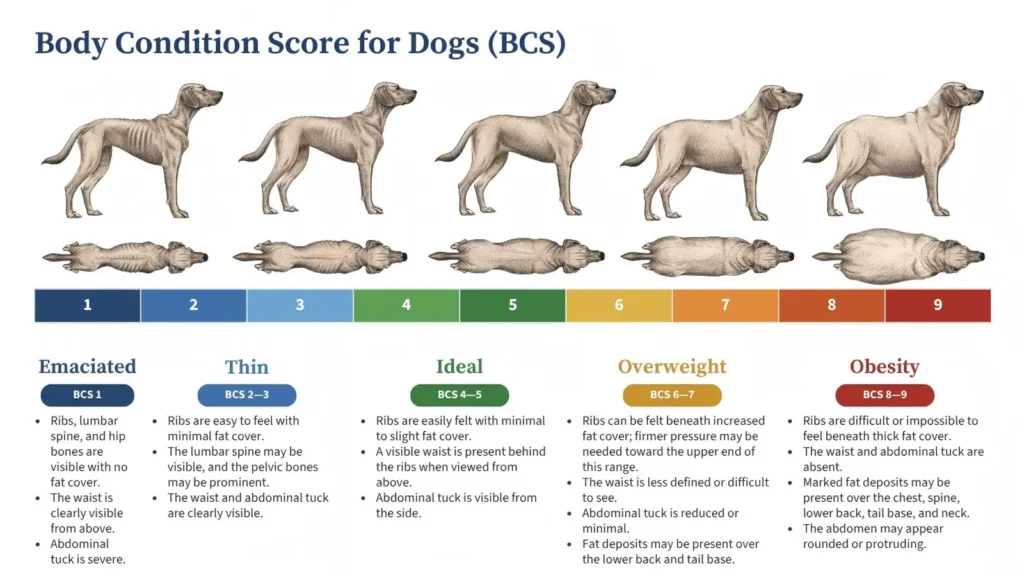
The feeding guide is a starting point. Adjust portions to your pet’s body condition (my body condition score guide explains how), and if your pet has a medical condition, choose the food together with your vet.
The Bigger Picture
Label rules are gradually making the back of the bag easier to read. In July 2023, AAFCO members approved a modernised US label with a “Pet Nutrition Facts” box, similar to the panel on human food, with a recommended six-year transition. Descriptive words on the front will continue to exist alongside it.
Neither side of the bag is the “true” one. The front tells you how a product is positioned; the back tells you what it is. Knowing which words are defined and which aren’t makes it easier to use both.
Takeaway:
- Natural, human grade, fresh, naming words and “free from” claims are regulated. They are not buzzwords.
- Premium, holistic, ancestral, vet-recommended, superfood, no fillers and clean label have no legal definition and guarantee nothing measurable.
- For nutrition decisions, read the complete-and-balanced statement, life stage and dry-matter analysis on the back.
What do you think? Which pet food word do you see most often, and would you like to see a definition for it?
References:
- Nutrient Requirements of Dogs and Cats (NRC, 2006) — Chapter 4, Carbohydrates and Fiber (starch digestion in dogs)
- AAFCO — Natural: https://www.aafco.org/consumers/understanding-pet-food/natural/
- AAFCO — Reading Labels: https://www.aafco.org/consumers/understanding-pet-food/reading-labels/
- AAFCO Official Publication 2024, Ch. 6 (official feed terms: Fresh, Natural, Human Grade): https://www.aafco.org/wp-content/uploads/2025/04/2024_OP_Chapter_6_enc.pdf
- AAFCO Human Grade Guidelines: https://www.aafco.org/wp-content/uploads/2023/01/Appendix_A_Human_Grade_Guidelines.pdf
- AAFCO — Pet Food Label Modernization approval (2023): https://aafco.org/news/aafco-membership-approves-new-model-pet-food-and-specialty-pet-food-regulations/
- FEDIAF Code of Good Labelling Practice for Pet Food (2019): https://europeanpetfood.org/wp-content/uploads/2022/02/FEDIAF_labeling_code_2019_onlineOctober2019.pdf
- UK Pet Food — Pet Food Labelling factsheet (2024): https://ukpetfood.org/asset/2D97C539%2D83D3%2D4E80%2DABB5EED0E5E9D588
- China MARA, 宠物饲料标签规定 (Announcement No. 20, 2018), FAOLEX copy: https://faolex.fao.org/docs/pdf/chn176389.pdf
- WSAVA Global Nutrition Committee — Selecting a pet food (2021): https://wsava.org/wp-content/uploads/2021/04/Selecting-a-pet-food-for-your-pet-updated-2021_WSAVA-Global-Nutrition-Toolkit.pdf
- Murphy, Schertz & Strawn (2022), A Consumer’s Guide: Overview of Pet Food Labels, Virginia Cooperative Extension FST-434: https://pubs.ext.vt.edu/FST/fst-434/fst-434.html
- Ohio State University Veterinary Medical Center — Myths and Misconceptions Surrounding Pet Foods: https://vmc.vet.osu.edu/resouces/myths-and-misconceptions-surrounding-pet-foods
- Axelsson E. et al. (2013). The genomic signature of dog domestication reveals adaptation to a starch-rich diet. Nature 495:360–364. https://doi.org/10.1038/nature11837