
I recently took over a Korean brand within our group; it will now be run by my team. The brand isn’t new. It’s an existing asset of the group. What’s new is who is responsible for it.
While sorting out the brand portfolio and talking with the local brand team, one idea has become much stronger for me: cross-cultural management is important to run a localized business, especially a brand. In those talks, I found that many of the rules in Korea are totally different from business in other parts of the world. Cross-cultural brand management is not a soft skill. It is how a brand survives outside its home market.
This article turns that idea into a cross-cultural brand management framework: why foreign brands fail, five steps, a table of what stays global and what goes local, and the leader’s role.
Disclosure: I work for a pet food company. No brand, group or company is named here, and nothing in this article is paid.
Every Market Has Its Own Rules
Every market, small or large economy, has its own rules. I’ve worked in the pet food industry since 2023, on the business and sales side. I built an overseas business from one partner country to 10. Today I’m the GM of an overseas brand unit, and I’m based in China.
Five lines, five rulebooks. And that’s only regulation. Then there’s how people shop, which platforms they trust and how they like a brand to speak to them. None of that is in a regulation table, yet all of it decides whether a brand sells.
Business schools have a name for this. In “Distance Still Matters” (Harvard Business Review, 2001), Pankaj Ghemawat described the CAGE framework: four kinds of distance between countries, which are cultural, administrative, geographic and economic. A market can be close on a map and still far away in the ways that matter.
Insight Box: When I was building partner markets, the hardest part was never the product. It was learning each market’s rules fast enough to avoid expensive mistakes.
Why Foreign Brands Fail: They Copy the Home Playbook
In my industry experience, I have seen a lot of business owners try to enter new markets regardless of local preference or culture. That normally ends in failure.
The home playbook feels safe because it worked at home. But a playbook is a set of answers to questions that were asked in a different market, where the channels, the language and the rules were different. Copying the playbook is easy. Making it work is not.
The pattern usually looks like this. Headquarters (HQ) picks the products, writes the claims, sets the price and chooses the channel. The local team is asked to “execute”. When sales are weak, HQ blames the execution and the local team blames the plan. Nobody learns anything.
Insight Box: In sales, the customer is always teaching you something. A local team is the same. It’s the closest thing you have to the customer’s voice inside your own company.
A Five-Step Cross-Cultural Brand Management Framework
Here is the framework I’m using as my team takes over the Korean brand. Each step is simple to write down and hard to do, because it asks the leader to hold back.
Step 1: Map the local rules before you change anything
Map four kinds of rules before you touch the plan.
Channel rules. In Korea, how and where products are sold is different from other markets: which channels matter, which platforms, how promotions run and how listings work. I saw a version of this in Turkey, where much of the branded kibble in one market was sold loose by weight: same products, sold a different way. In Korea, two large domestic platforms show why channels matter. KED Global describes Coupang as South Korea’s largest e-commerce platform. In 2024, Coupang added a free tool in its pet supplies category that gives owners customised food recommendations. In a 2023 Opensurvey poll of online shoppers, reported by Maeil Business Newspaper, Coupang and Naver Shopping together held almost 65% of the online mall market by that survey’s measure.
When a few platforms carry that much of the market, the platform’s rules become your brand’s rules. So ask your team: which platforms matter for our category? How do listings, reviews and promotions work on each? What does each platform expect that HQ has never had to provide?
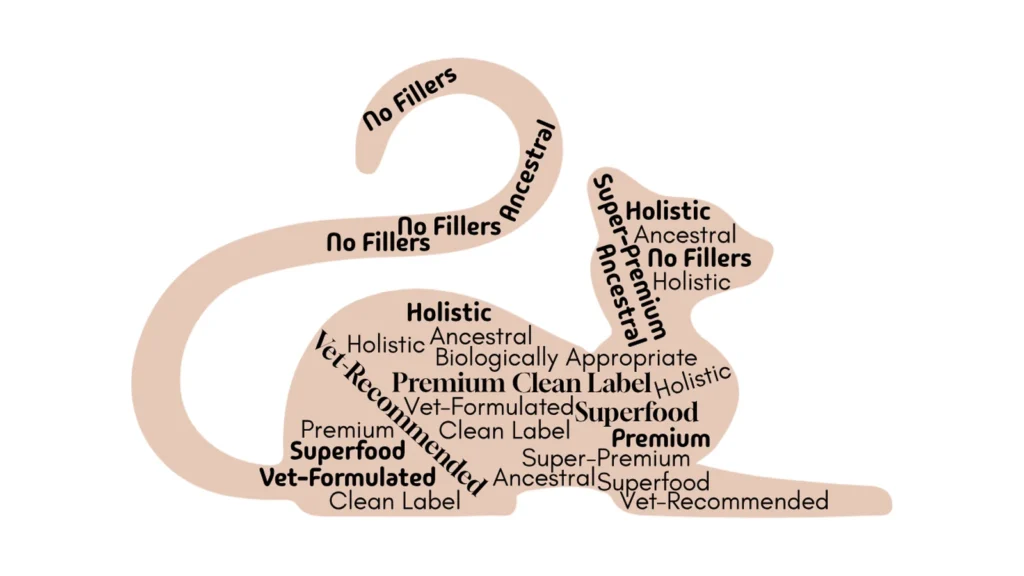
Product language. This is how a product speaks: packaging copy, naming, tone, Korean-first language and the way benefits are expressed, all different from what works elsewhere. On pet treats there, I’ve noticed Korean-first packaging with playful characters, a long way from the restrained style of many Western packs. For imported goods, the US Commercial Service also notes that Korea expects any English label information to match the Korean label. So ask: how would a local customer describe this product’s benefit in their own words? Label words are never neutral, as I found when I looked at pet food buzzwords that have no legal definition.
Regulation. This one is moving. On 3 September 2025, Korea’s Ministry of Agriculture, Food and Rural Affairs changed its feed standards to create separate labelling rules for dog and cat food. Under the new rules:
- Food that meets the nutrient needs of a life stage can be labelled “complete pet feed”. Other products are “other pet feed”.
- If an ingredient appears in the product name, its content must be shown.
- Endorsements by vets or professors are generally not allowed.
The rules take effect in September 2028. In December 2025, the ministry said it was considering about one more year of grace. Product language is being written into law.
Consumer habits. How people feed, how often they buy, what they compare before buying. I won’t pretend to have those answers for Korea yet. That’s the point of the map: the questions come first.
Insight Box: Most leaders want to start with a strategy. I think you should start with a map. A strategy built without a map is just a guess with a slide deck.
Step 2: Decide what stays global and what goes local
Some things must not change: the brand’s core, its quality standards and its values. If these move, there is no brand left, just a logo on different products.
Other things must change: the channel plan, pack copy, promotions, tone of voice and price points by channel. If these stay fixed, the brand becomes a foreign object in the market. The hard part is the middle, where decisions need a conversation, not a rule.
| Stays global | Needs a conversation | Goes local |
|---|---|---|
| Brand core and positioning | Packaging design | Channel and platform plan |
| Quality and safety standards | Product names | Pack copy and tone |
| Values and promises | Lead product | Promotions and listings |
| Proof behind every claim | Product range (sizes, recipes) | Price points by channel |
A useful test for the middle column: what would the customer lose if this element changed? If the answer is “trust in the brand”, keep it global. If it’s “nothing they would notice”, let the market decide.
Step 3: Listen to local professionals and give them decision rights
The people in the local team know things I can’t know from China or the Netherlands. They know the platforms, the buyers, the regulators and the customers in a way no headquarters can.
I wrote about the same habit in managing an AI team as a non-developer: when experts know a field you don’t, borrow their way of working and keep your judgement for the decisions only you can make. A local team is that kind of expert, and one you can’t replace from abroad.
But listening isn’t enough. If you listen and then keep every decision at HQ, you haven’t really listened. Give the local team real decision rights where local knowledge wins: channel tactics, promotions, local copy and local partners. Ask yourself: which decisions am I keeping only because I’m used to making them?
Insight Box: A simple test of whether HQ is really listening: count the decisions the local team has made that HQ would not have made. If the answer is zero, the team is executing, not leading.
Step 4: Set up a two-way “translator” rhythm
HQ and the local team need a regular rhythm in which each side explains itself. HQ explains why the brand core matters and what the group needs. The local team explains why a market rule matters and what it costs to ignore it. Someone has to translate the logic, not just the language.
A regular call with a fixed agenda works better than scattered messages. Each side should leave knowing what the other decided and why. End each call with one question: what did HQ learn from the market today?
Step 5: Test locally, measure, then scale
Don’t roll out a big change all at once. Test it in one channel or with one product, measure, then scale. Testing protects the brand from HQ’s mistakes and from the local team’s blind spots. Nobody is right by default. Before each test, agree on one question: what result would make us stop?
The Leader’s Role: Protect the Core, Free the Rest, Be Ready for All Issues
The leader’s job is to protect the core and free the rest. You are the person who says “this must not change” and also “this is your call.” Both sentences matter. If you only say the first, you become a bottleneck. If you only say the second, the brand drifts.
The leader also filters well-meant “help” from headquarters: templates, campaigns, product ideas. Some of it is useful. Some of it is the home playbook coming in through the back door. The leader decides which is which, and explains why in both directions.
Finally, the leader sets the pace. A handover creates pressure to show change quickly, but the fastest visible change is usually the riskiest, because it’s made before the map is finished. I’d rather spend the first months learning, and change fewer things for better reasons.
Insight Box: A local rule is not an obstacle to the brand. It’s information about the customer that someone has already paid to learn.
Takeaway:
- A brand travels across borders only when its leader separates the core that stays global from everything that should go local.
- Map the local rules (channels, product language, regulation, habits) before changing anything.
- Listening only counts when the local team gets real decision rights.
What do you think? If you took over a brand in another country tomorrow, which decision would you hand to the local team first, and which one would you refuse to give away?
References:
- WEF Advanced Pet Nutritionist course notes (2026), 8.3.3 export requirements by market
- Ghemawat, P. (2001). “Distance Still Matters: The Hard Reality of Global Expansion.” Harvard Business Review, September 2001: https://hbr.org/2001/09/distance-still-matters-the-hard-reality-of-global-expansion
- KED Global, “Coupang launches Rocket Pet Doctor 2.0 with personalized pet nutrition” (13 November 2024): https://www.kedglobal.com/e-commerce/newsView/ked202411130005
- Maeil Business Newspaper via Daum, “Coupang, Naver Shopping dominate Korean online mall market with 65% share” (20 June 2023; Opensurvey data): https://v.daum.net/v/20230620121502871
- International Trade Administration, “South Korea — Labeling/Marking Requirements”, Country Commercial Guide: https://www.trade.gov/country-commercial-guides/south-korea-labelingmarking-requirements
- DailyVet (데일리벳), separate standards for dog and cat feed introduced (4 September 2025): https://www.dailyvet.co.kr/news/policy/256528
- DailyVet (데일리벳), additional one-year grace period under review (16 December 2025): https://www.dailyvet.co.kr/v/266971